

Walking Through Daniel: The Book With Three Voices
Part 1: Introduction

Hello brothers and sisters,
It’s no secret that I love the book of Daniel. It is so rich, with so much soft spoken theology, so many promises, so many prophecies, and truly one of the most remarkable men in all of Scripture (not to mention one of the clearest depictions of spiritual warfare in the entire Bible)!
Now, I want to tell you something that most Christians have never heard, something that might genuinely surprise you: the book of Daniel exists in three different ancient versions. And when I say “different,” I don’t mean minor spelling variations or slightly different word choices. I mean that in some chapters, these three versions tell the story in dramatically different ways, with entire sections that appear in one version and are completely absent from another.
What makes this even more remarkable is that one of these versions was so thoroughly replaced in church history that for over a thousand years, almost nobody even knew it existed.
This is the story of the three voices of Daniel. And we’re going to listen to all three of them.
If you’re reading this in email, be aware that the text is likely to cut off without warning. For a smoother reading experience and all the features Substack has to offer (including audio voiceovers of my posts), you can go HERE or download the app.
The Version You’ve Never Read
If you’ve ever picked up a study Bible or a parallel Bible that includes the “Septuagint version” of Daniel, there’s something you need to know: you almost certainly weren’t reading the original Greek translation.
Let me explain.
For most books of the Old Testament, when we talk about “the Septuagint,” we’re talking about the Greek translation produced by Jewish scholars in Alexandria, Egypt, beginning around 270 B.C. That translation is what the apostles quoted, what the early church preached from, and what shaped Christian theology for the first several centuries of the faith.
Daniel was part of that translation. Jewish scholars rendered the Hebrew and Aramaic text of Daniel into Greek, probably sometime in the second century B.C. Scholars call this version the “Old Greek” (or OG for short), and it is the earliest Greek translation of Daniel that we know of.
But here’s the twist: by the first or second century A.D., the early church had almost entirely stopped using the Old Greek of Daniel. They replaced it with a different Greek translation, one attributed to a Jewish translator named Theodotion.
The replacement was so thorough that for over a millennium, only two manuscripts of the original Old Greek survived. Two. Out of the countless copies of the Greek Bible produced across the ancient world, the Old Greek of Daniel was preserved in a single medieval manuscript (Codex Chisianus, dating to somewhere between the 9th and 11th centuries) and one early papyrus (Papyrus 967, dating to the 2nd or 3rd century A.D., discovered in Egypt in 1931).
Everything else was Theodotion’s version, passed off under the label “Septuagint” for centuries.
Daniel is the only book of the Bible where this happened. For every other Old Testament book, the original Septuagint translation remained the standard Greek text. But for Daniel, the church made a conscious decision to swap one Greek translation for another.
The question is why.
Why the Church Replaced Its Own Bible
To understand the replacement, you have to understand the difference between the two translations.
The scholarly consensus is that the Old Greek translator of Daniel took a relatively free approach to the text. He wasn’t doing a word-for-word rendering; he was telling the story in Greek, sometimes expanding the narrative with additional details, sometimes condensing it, sometimes offering what amounts to an interpretive paraphrase rather than a strict translation.
However, as I often do, I would like to challenge this just a bit and suggest the possibility that this translator was simply working from a different source text than the ones we have today. After all, we have evidence from the Dead Sea Scrolls that there were multiple versions of several books of the Bible in circulation at the time. Nothing tells this story more plainly than the finding of two wildly different versions of Jeremiah in the scrolls that were preserved by the community at Qumran, with neither showing any signs of being preferred over the other.
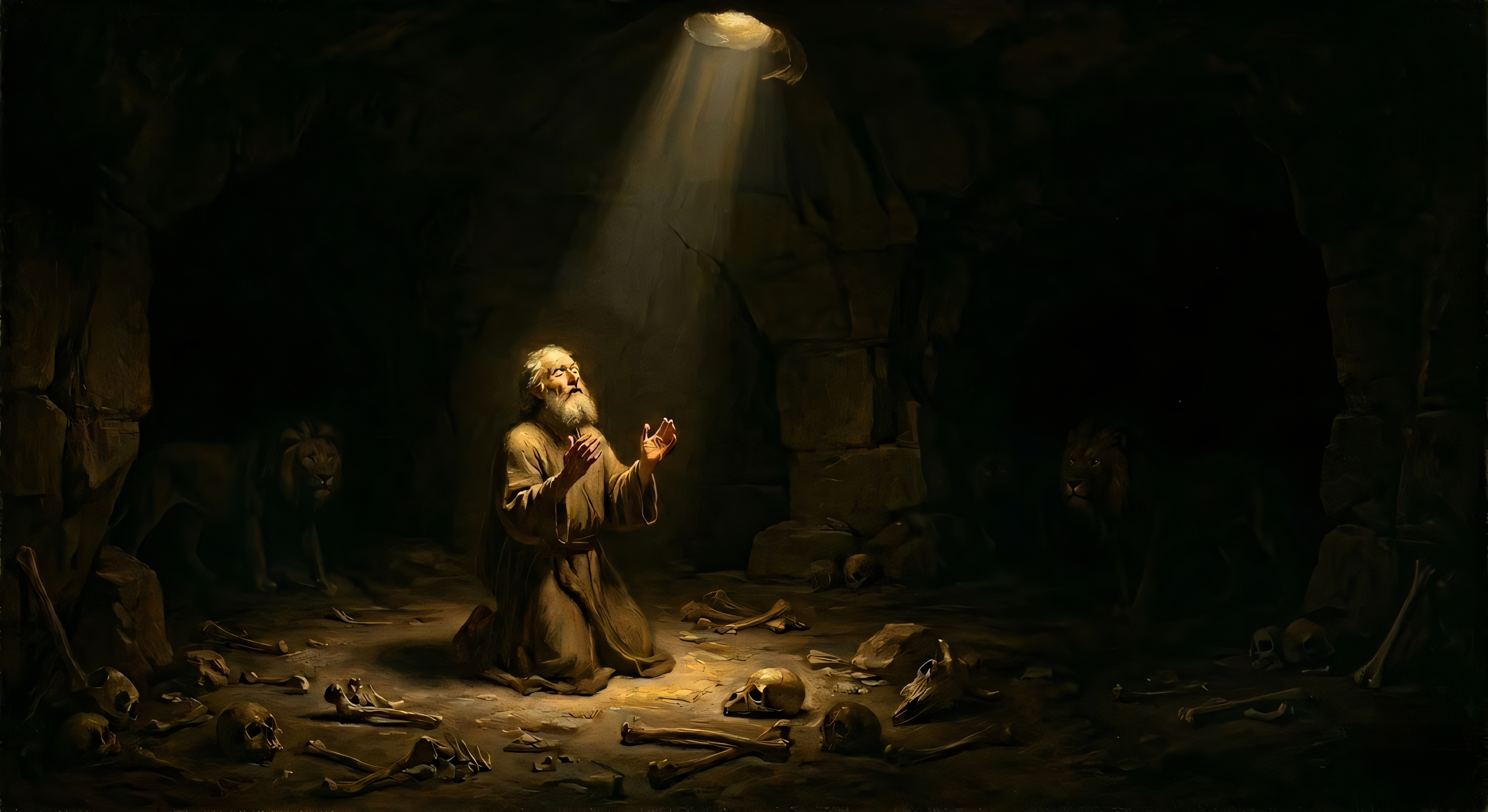
Now, in the narrative chapters (especially chapters 4 through 6), the Old Greek version diverges wildly from the Hebrew and Aramaic text that we know from the Masoretic tradition. The Old Greek version of chapter 4 (Nebuchadnezzar’s madness) and chapter 6 (the lions’ den) are both significantly longer than what we find in the Masoretic Text, with expanded dialogue, additional narrative details, and more vivid characterization. Chapter 5 (the writing on the wall), by contrast, is significantly shorter in the Old Greek, omitting large portions of Daniel’s speech to Belshazzar.
How different are we talking? A detailed comparison of the Greek texts in Daniel 4 through 6 reveals that less than 19% of Theodotion’s vocabulary matches the Old Greek in those chapters. When they do agree, about 83% of the shared vocabulary is verbatim, which strongly suggests that what little agreement exists is due to later scribal correction of Old Greek manuscripts toward Theodotion’s text rather than to any shared textual tradition.
To put that plainly: in those three chapters, the Old Greek and Theodotion are essentially different books.
Theodotion’s version, by contrast, hews much more closely to the Hebrew and Aramaic text that has survived in the Masoretic tradition. It follows the word order more carefully, uses more consistent vocabulary equivalents, and produces a Greek text that can be mapped back onto the Semitic source with relative ease. For Christians who were debating with Jewish scholars about messianic prophecies in Daniel, or for church fathers who wanted to cite Daniel in doctrinal disputes, Theodotion’s closer alignment with the Hebrew made it a more useful tool.
Jerome, writing in the fourth century, noted bluntly that the Old Greek version of Daniel had been rejected by the churches because it “differs widely from the original.” Origen, a century before Jerome, had already given Theodotion’s Daniel a prominent place in his Hexapla (his monumental six-column comparison of biblical texts), and in his own writings, Origen almost invariably quoted Daniel from Theodotion rather than the Old Greek.
The early church made a pragmatic decision: Theodotion’s Daniel was more useful, more defensible, and closer to the Hebrew that their Jewish interlocutors recognized. So they adopted it. And the Old Greek was quietly set aside.
But Here’s the Irony
As I mentioned above, the irony is that the Old Greek may preserve older readings. The Dead Sea Scrolls fragments of Daniel (found in eight manuscripts across Caves 1, 4, and 6 at Qumran) occasionally side with the Old Greek against both the Masoretic Text and Theodotion.
And there’s another wrinkle. The text we call “Theodotion’s Daniel” may not actually be Theodotion’s at all.
The historical Theodotion is traditionally dated to the second century A.D., during the reign of Emperor Commodus (around 190 A.D.). But quotations from “Theodotion’s Daniel” appear in texts written well before that, including in the Shepherd of Hermas and in the writings of Justin Martyr, both from the mid-second century. The New Testament itself, written in the first century, occasionally appears to quote Daniel in forms that align more closely with Theodotion than with the Old Greek.
How can a translation be quoted before its supposed translator was even born?
Contemporary scholarship has largely resolved this puzzle. The text we call “Theodotion’s Daniel” most likely belongs to an earlier tradition known as the Kaige recension, a first-century B.C. revision of the Old Greek that systematically brought the text closer to the Proto-Masoretic Hebrew version. A historical translator named Theodotion may have existed in the second century, but the Daniel text attributed to him was already in circulation at least a century before he lived. His name was attached to a pre-existing text, much like a brand name being applied to a product that someone else invented.
What this means for us is significant: the text that replaced the Old Greek in church use wasn’t a late, secondary translation. It was itself an ancient witness, probably originating in the first century B.C. in Judea, reflecting a Jewish scholarly tradition that valued close alignment with the emerging standard Hebrew text.
So we don’t have a “good” Greek translation and a “bad” one. We have two ancient Greek witnesses, each with its own character, its own strengths, and its own history. And we have the Hebrew and Aramaic Masoretic Text.
Three voices. Three witnesses. One book.
What We Have, Then
Let me lay out what we’re working with in this series.
The Masoretic Text is the Hebrew and Aramaic text of Daniel as preserved by Jewish scribes across the centuries. It’s the basis for virtually every English translation you’ve ever read, whether that’s the NKJV, the NRSVUE, the NIV, or any other modern Bible.
Now, this is where my both/and position gets slightly complicated.
There is no direct evidence that the Old Greek version of Daniel is based on an older Hebrew/Aramaic source. There is no manuscript or even fragment that suggests there is an ancient version of the text that matches the differences found in the Old Greek.
The Dead Sea Scrolls provide strong confirmation of the Masoretic Text’s reliability here. Fragments from every chapter except chapter 12 have been found at Qumran (and even chapter 12 is indirectly attested, since the non-biblical scroll known as the Florilegium quotes Daniel 12:10).
So does this mean the Old Greek version is just a bad translation?
Not in the slightest. Here’s the thing to remember: just because we’ve never found one doesn’t mean it doesn’t exist. There is enough evidence supporting the idea that the Septuagint readings represent different vorlagen (source texts) that it is reasonable (though not defensible, evidentiarily speaking) to take the position that most if not all of the different readings in the Greek are representative of older Hebrew manuscripts that no longer exist.
Just remember that we have no such extant text proving that the Old Greek of Daniel came from a different Hebrew source.
Now, Daniel is unusual among Scripture in that it’s bilingual. The book opens in Hebrew (1:1 through 2:4a), then switches to Aramaic at 2:4b. From there it stays in Aramaic until 7:28, where it switches back to Hebrew for the remainder of the book.
We’ll explore why that matters when we reach chapter 1 in the next post.
The Old Greek is the earliest translation of Daniel, produced by Jewish scholars probably in the second century B.C., though some scholars suggest it could have been translated in the 3rd century.
Specifically, Robert Dick Wilson argues that it contains linguistic forms consistent with 3rd century usage rather than 2nd. While E.W. Bullinger maintained that the entire Old Testament was translated between 285 and 270 B.C. (though he appears not to have had any evidence beyond the semi-legendary Letter of Aristeas). That fact is debated though, for while in some uses the Hebrew term “The Law” was used to identify the entire Old Testament, most scholars agree that even in ancient usage, the term typically referred only to the first five books (the Pentateuch or Torah), traditionally attributed to Moses.
And why does that matter? you might be asking. Well, simply put, the dating of the original authorship of the book of Daniel is highly debated. Largely on account of the incredibly specific prophecies that predicted the fall of the Babylonian, Medo-Persian, and Greek empires as well as the ascendancy and decay of the Roman Empire.
My contention, as some scholars note, is that we have pretty convincing evidence that Daniel was written considerably before the late 2nd century B.C. that most critical scholars agree on. Many consider it’s authorship to be as late as 100 B.C.
J. Paul Tanner argues that while the late 2nd century is the “critical” consensus, the fact that the book of Daniel had already appeared in Qumran with significant textual variants speaks to a much earlier authorship.
Consider, based on traditional paleographic dating techniques, the fragments of Daniel that have been found among the Dead Sea Scrolls have been dated to between 125 B.C. and around 50 A.D. Clearly, this presents a problem for the critical scholarly consensus. Especially when we consider the 2025 study that places the dating of those fragments potentially as early as 230 B.C.!
So, even if the 2025 study is flawed and the earliest reliable dating we have is to 125 B.C., a text does not become authoritative and accepted as canon Scripture AND develop significant textual variants in just a couple of decades. In todays world, yes, absolutely, but in ancient Israel?
I find the arguments for that unconvincing.
Now, back to the Old Greek version. It survives in very few manuscripts, the most important being Papyrus 967 (2nd-3rd century A.D.) and Codex Chisianus (9th-11th century A.D.).
The Old Greek is thought by most scholars to be a freer translation, sometimes expanding the narrative, sometimes compressing it, and occasionally diverging so dramatically from the Masoretic Text that scholars debate whether the Old Greek translator was working from a different Hebrew/Aramaic source text (as we discussed above) or was simply taking significant interpretive liberties.
For our English rendering of the Old Greek, we’ll be using the N.E.T.S. (New English Translation of the Septuagint) as it’s the most accessible English translation.
Theodotion (or more accurately, the Kaige-Theodotion tradition) is the Greek text that replaced the Old Greek in church use by the first or second century A.D. It follows the Hebrew and Aramaic much more closely than the Old Greek does, making it a more transparent window into the Semitic source text.
Theodotion’s Daniel is what you’ll find in most printed editions of the Greek Septuagint today. For our English rendering of Theodotion, we’ll be using Brenton’s English Translation of the Septuagint.
One interesting detail worth noting: the earliest Old Greek manuscript, Papyrus 967, arranges the chapters of Daniel differently from the Masoretic Text. In Papyrus 967, chapters 7 and 8 are placed before chapters 5 and 6. This actually follows the chronological order of events in the book (the visions of chapters 7 and 8 are dated earlier than the events of chapters 5 and 6), rather than the thematic arrangement we find in the Masoretic Text, where all the stories come first (chapters 1-6) and all the visions follow (chapters 7-12).
Even the structure of the book has more than one voice.
Why Three Voices Matter: The Both/And Framework
If you’ve been reading The LXX Scrolls for any length of time, you know that the heart of everything I do here is what I call the “both/and” hermeneutic. It’s the conviction that both the Masoretic Text and the Septuagint are authoritative, that both have been intentionally preserved by God, and that together they tell a fuller story than either tells alone.
This isn’t a compromise position. It’s not splitting the difference between competing claims. It’s the recognition that God chose to preserve His Word through multiple faithful communities, in multiple languages, across multiple centuries, and that the differences between these traditions aren’t errors or corruptions. They’re harmonies. Different angles on the same truth.
With Daniel, we get to extend that framework to three voices instead of two. And the results are extraordinary.
When all three traditions agree (which they often do, especially in the visionary chapters 7 through 12), our confidence in the text grows. Three independent witnesses confirming the same reading is powerful evidence of careful transmission.
When two traditions agree against the third, we get to ask why the third diverges. Is it preserving an older reading? Offering a theological interpretation? Working from a different source? Every divergence is an invitation to dig deeper.
And when all three traditions say something materially different (which happens more than you might expect, particularly in chapters 4 through 6), we get to hold those differences together and ask: what does each voice contribute to our understanding of what God is saying through this text?
As I say so often, this isn’t about finding contradictions. It’s so much more important than that. This work is all about finding the fullness of Scripture across multiple witnesses.
How This Series Will Work
Starting with the next post, we’re going to walk through Daniel chapter by chapter, verse by verse. Here’s how we’ll handle the three-version comparison:
When all three traditions say essentially the same thing (which is the majority of the time), we’ll present a single English translation, choosing whichever version best captures the point of the verse. We’ll note in passing where the Greek versions have minor or superficial differences.
When two or all three traditions diverge in a meaningful way, we’ll lay out each divergent version side by side so you can see the differences for yourself. These are the moments where the comparative reading pays off, and we won’t rush through them. And as always, I’ll be providing cultural and historical context throughout.
For the most part, I’ll reserve my own personal reflections for the end of each chapter. For the body of each post, I want the texts to speak for themselves so you can draw your own conclusions. You don’t need me telling you what to think about what you’re reading. But I will discuss any competing interpretations and scriptural connections, and at the end I’ll share where the text lands for me personally.
From there, as always, you can accept my perspective or not. I’ve said this before but it bears repeating. My goal with these discussions is not to convince you of my position. I don’t want to change your mind. I just want to provide you with as much information as I can, then point you back to Scripture and give you the opportunity to be as noble as the Bereans (see Acts 17:11).
Fair warning: some of these posts will be long. Daniel is dense. The textual comparisons add a layer that most commentaries skip entirely. But I promise you this: you are going to see things in this book that you have never seen before, even if you’ve read Daniel a hundred times.
A Word About the Additions
Both Greek traditions (the Old Greek and Theodotion) include material that isn’t found in the Masoretic Text. These are commonly known as the “Additions to Daniel”:
The first is the Prayer of Azariah and the Song of the Three Young Men, which is inserted into the middle of chapter 3. It rests between what we know as verses 23 and 24 in our English Bibles. It contains a beautiful penitential prayer and one of the most magnificent hymns of praise in all of ancient literature.
Susanna is the story of a righteous woman falsely accused by corrupt elders and vindicated by a young Daniel’s wisdom. In some Greek manuscripts, this story appears as a prologue before chapter 1; in the Vulgate, it’s placed as chapter 13.
Bel and the Dragon, two short narratives in which Daniel exposes the fraudulence of idol worship with almost detective-story logic. These are usually placed as chapter 14.
These additions are considered canonical Scripture by the Catholic, Eastern Orthodox, Oriental Orthodox, and Assyrian churches. Protestant tradition does not include them in the canon. They are not attested in the Dead Sea Scrolls.
Regardless of where you land on their canonical status, I find these additions genuinely fascinating. They tell us how ancient Jewish and Christian communities understood Daniel’s character, his calling, and his relationship with God. We’ll be giving them their own dedicated post at the end of this series.
If you’ve found this work insightful or helpful, please share it with a friend who loves Scripture as much as you do.
What’s Coming
Here’s the roadmap. Over the coming Weeks, we’ll work through:
Every chapter of Daniel (1-12), with verse-by-verse textual comparison and historical context.
A dedicated post on the Additions (Susanna, Bel and the Dragon, and the Prayer of Azariah).
Chapters that diverge dramatically between the three traditions (especially chapters 4, 5, and 6) will get extra attention.
Chapter 9 (the Seventy Weeks) will receive a focused treatment of Daniel’s prayer (one of the most remarkable prayers in all of Scripture) with a condensed discussion of the prophecy itself and a link to my existing in-depth post on Daniel’s Seventy Weeks prophecy for those who want to dig into (or reread) the full deep dive.
Some chapters may be split across two posts if the material runs long. I’d rather give a chapter the space it deserves than rush through it or dump a 12,000 word post on you.
This is going to be a journey. Daniel is one of the most complex, most debated, and most rewarding books in the Bible. It has court tales and apocalyptic visions, earthly politics and heavenly warfare, lions’ dens and the Ancient of Days. Not to mention the first reference to the Messiah as the Son of Man. It was written in two languages, preserved in three traditions, and it speaks as powerfully today as it did when Daniel first received these words in Babylon twenty-five centuries ago.
I’m so glad you’re here for this.
I can’t wait to dig in.
If you want to go deeper into the Word with a deep 8-part exploration of biblical idolatry with modern context, an 8-part series exploring the idiom of a woman in travail as a metaphor for the end times, and other exclusive content (including my ongoing exploration of the Divine Court), consider becoming a paid subscriber for just $7/month. Your support keeps the scrolls unrolling.
Prefer to own what you read?
My completed teaching series are available as ebooks and AI-read audiobooks. Buy on my Curios store to support my work most directly, or find them on Amazon at slightly higher prices if you prefer reading on your Kindle device.
But if neither of those is feasible right now but my work has blessed you, engaging in the comments or sharing this post with someone who’d find it meaningful is genuinely the best support you can give.
Thank you so much for being part of this journey.
© 2026 LXX Scrolls. All rights reserved.
I learned a lot from this post. You've done a great job taking something complicated and making it simple. I'm definating looking forward to the rest of this series!
I just want to clarify...
The NETS translation used the Old Greek and Brenton's use the Theodotion version.
Is that correct?