

A Mother's Anguish, A Mother's Song
A Mother’s Day Reflection on the Song That Started It All

Hello brothers and sisters,
Today is Mother’s Day, and I want to sit with you for a few minutes around one of the most remarkable women in all of Scripture. A woman whose tears were witnessed by God, whose prayer was answered against all odds, and whose song became the template for the song Mary would sing a thousand years later.
Her name is Hannah. And before we get to her song, we have to walk through her sorrow.
If you’re reading this in email, be aware that the text is likely to cut off without warning. For a smoother reading experience and all the features Substack has to offer (including audio voiceovers of my posts), you can go HERE or download the app.
A Woman Who Wanted to Be a Mother
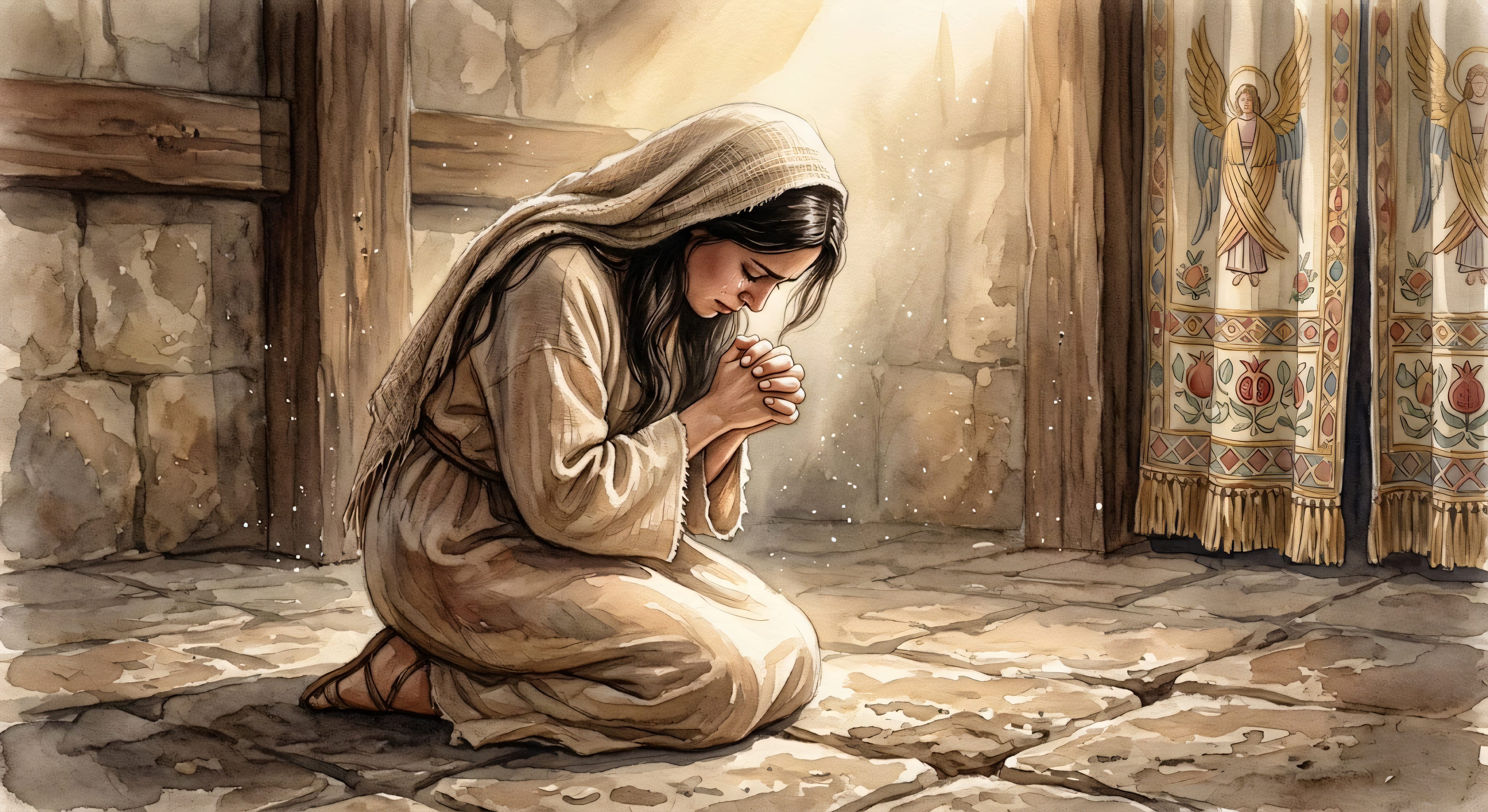
The story opens with a household full of tension. Elkanah loved his wife Hannah, but she had no children, and his other wife, Peninnah, did. Year after year, the family made the pilgrimage to the house of the Lord at Shiloh, and year after year, Hannah’s anguish was reopened like a wound.
The text in the Septuagint puts it plainly:
“because the Lord did not give her a child despite her anguish and despite the hopelessness of her anguish. She lost heart because of this: that the Lord kept her womb closed by not giving her a child. This is how she behaved year after year when she would go up to the house of the Lord: She was disheartened and wept and did not eat.” (1 Kingdoms 1:6-7, LES)
Read that again. The hopelessness of her anguish. Year after year. Disheartened and weeping and unable to eat.
This is the part of Hannah’s story I don’t want us to rush past. Because today, in churches all over the world, women are sitting in pews carrying this exact weight. Women who have wanted children for years and never received them. Women who have lost children and live with grief that resurfaces every Mother’s Day. Women who feel passed over, forgotten, or unseen.
Hannah was one of you. And the Holy Spirit thought her tears were important enough to preserve in Scripture forever.
At the Temple
Eventually, Hannah’s grief drove her to the only place it could go. She went to the house of the Lord and poured out her soul before God. Her vow is one of the most beautiful prayers in Scripture:
“Adonai, Lord Eloai Sabaoth, if you are looking, you are looking upon the humiliated state of your slave. Remember me and give your slave seed of men, and I will give him to you as a devoted one until the day of his death.” (1 Kingdoms 1:11, LES)
Notice how she addresses God. Not casually. Not familiarly. Adonai, Lord Eloai Sabaoth. Three reverent titles stacked together, the way you reach for someone’s full name when you really need them to hear you.
And notice what she asks for: “seed of men.” That phrase echoes back to the very first promise God made after the Fall, in Genesis 3:15, where the seed of the woman would crush the serpent’s head. Hannah isn’t just asking for a child. She’s asking to be part of a story that goes back to Eden and forward to the Messiah. She doesn’t know it yet, but the son she’s praying for will be the prophet who anoints David, the king from whose line the true Seed will come.
Her prayer was so intense, so consuming, that the priest Eli mistook her for a drunk woman:
“And Hannah answered and said, ‘No, sir! I am a woman who has had a hard day. And I have not drank wine and intoxicating drink, and I am pouring out my soul before the Lord. Do not regard your slave as a pestilent daughter because I have been stretching out my great number of words until now.’” (1 Kingdoms 1:15-16, LES)
A woman who has had a hard day.
Friends, if there’s a more honest description of what it feels like to bring our deepest grief to God, I haven’t found it. Hannah doesn’t dress up her prayer. She doesn’t perform piety. She just says, in essence, “I am a woman who has had a hard day, and I am pouring out my soul before the Lord.”
That’s a prayer you can pray today.
The Lord Remembered Her
What happened next is captured in one of the most beautiful sentences in all of Scripture:
“Elkanah entered his house at Ramah and knew Hannah, his wife, and the Lord remembered her. And she conceived, and it happened at the time of the days she bore a son and called his name Samuel.” (1 Kingdoms 1:19-20, LES)
The Lord remembered her.
Not because He had ever forgotten. God doesn’t forget. But Scripture uses this language to mark moments when God acts on what He has always known. He remembered Noah in the ark. He remembered His covenant with Abraham. And here, He remembered a weeping woman at Shiloh whose tears had been counted, whose prayers had been heard, whose anguish had never escaped His notice for a single moment.
If you are waiting today, the God who remembered Hannah remembers you.
Giving Him Back
Here’s the part of Hannah’s story that, as a father, just hits different. Once Samuel was weaned, she kept her vow. She brought him to Shiloh and gave him back to the Lord:
“For this is the child I prayed for, and the Lord gave my request that I asked from him. And I have given him to the Lord all the days that he lives to be used by the Lord.” (1 Kingdoms 1:27-28, LES)
She prayed for years to receive him, and then she gave him away.
This is a kind of faith I’m not sure I’ll ever fully understand and I can only dream of having. The mothers I admire most are the ones who hold their children with open hands, who know from the very beginning that their children belong to God first. Hannah is the patron saint of that posture. She received what she had begged for, and then she let it go, because she trusted that the God who gave was wiser than her grip.
And it’s this Hannah, the Hannah who wept and prayed and received and surrendered, who breaks into one of the most extraordinary songs in all of Scripture.
Hannah’s Song
I want to read this slowly. Sit with it. This is a woman who has walked through years of barrenness and ridicule and finally found her voice:
“My heart was made firm in the Lord; my horn was lifted high in my God: my mouth was widened against my enemies. I was glad in your deliverance. because no one is holy like the Lord, and no one is righteous like my God; there is no one holy except you.
Do not boast, and do not speak lofty words nor allow big talk to come out of your mouth, because the Lord is a God of knowledge and a God who prepares his own business.
The bows of the mighty have become weak, and those who were weak have been clothed with might. Full of bread, they suffer loss, and being weak, they neglect the land. For the barren woman bore seven, and the woman who is many in children has become weak.
The Lord puts to death and brings to life; he leads down to the grave and leads up. The Lord makes poor and makes rich; he humbles and exalts. He lifts up the poor from the earth, and from the dung pile he raises the beggar to sit him with the princes of the people and makes them to inherit the throne of glory.” (1 Kingdoms 2:1-8, LES)
Notice the past tense. My heart was made firm. My horn was lifted high. I was glad in your deliverance. Hannah isn’t just hoping anymore. She’s looking back. She has walked through the valley, and now she stands on the other side and sings about what God has already done.
The song builds toward a sweeping vision of God’s reversal of all human pride. There’s a section in the middle of the song, found in the Septuagint, that mirrors the prophet Jeremiah:
“The wise must not boast in his wisdom, and the strong must not boast in his strength, and the wealthy must not boast in his wealth. Rather the one who boasts should boast in this: to understand and to know the Lord and to practice justice and righteousness in the midst of the land.” (1 Kingdoms 2:9b-10a, LES)
Although not quite word for word, this is close enough to the Septuagint text of Jeremiah 9:23-24, woven directly into Hannah’s song, that some scholars view it as the translators inserting the text directly from Jeremiah.
Either way, notice that this woman’s prayer doesn’t just speak for herself. It speaks for the prophetic tradition. Hannah is singing the same song that every prophet of Israel will sing, that wisdom and strength and wealth are nothing, and the only true boast is knowing the Lord. Which creates an interesting parallel with Paul in Galatians 6:14 when he says that he’ll boast in nothing unless it be our Lord Jesus Christ.
And then comes the closing line, the one that turns everything we’ve just read into a Messianic prophecy:
“The Lord went up into the heavens and thundered. He will judge the heights of the earth and give strength to our kings, and he will lift high the horn of his anointed.” (1 Kingdoms 2:10b, LES)
The horn of his anointed. The Greek word here is christou, the same word the New Testament uses for Christ. A thousand years before Mary cradled her newborn Son and called Him Jesus, a barren woman in Shiloh sang about Him. Knowingly or not.
The Mother Who Sang After Her
When Mary visits her cousin Elizabeth in Luke 1, and Elizabeth blesses her, Mary breaks into song. We call it the Magnificat. And anyone familiar with Hannah’s prayer hears it immediately:
“And Mary said: ‘My soul magnifies the Lord, And my spirit has rejoiced in God my Savior. For He has regarded the lowly state of His maidservant; For behold, henceforth all generations will call me blessed. For He who is mighty has done great things for me, And holy is His name. And His mercy is on those who fear Him From generation to generation. He has shown strength with His arm; He has scattered the proud in the imagination of their hearts. He has put down the mighty from their thrones, And exalted the lowly. He has filled the hungry with good things, And the rich He has sent away empty. He has helped His servant Israel, In remembrance of His mercy, As He spoke to our fathers, To Abraham and to his seed forever.’” (Luke 1:46-55, NKJV)
Look at the echoes:
Hannah: “My heart was made firm in the Lord.” Mary: “My soul magnifies the Lord.”
Hannah: “He looked upon the humiliated state of your slave.” Mary: “He has regarded the lowly state of His maidservant.”
Hannah: “The bows of the mighty have become weak, and those who were weak have been clothed with might.” Mary: “He has put down the mighty from their thrones, and exalted the lowly.”
Hannah: “Full of bread, they suffer loss.” Mary: “He has filled the hungry with good things, and the rich He has sent away empty.”
This is why I wanted us to read Hannah’s song from the Septuagint today. Mary is singing the Bible she knew. The Greek Old Testament that shaped her prayers and her worship and her understanding of who God is. When the angel announced that she would bear a Son, Mary reached for the song of another mother who had been remembered by God, and she made it her own.
Two women. A thousand years apart. Singing the same song about a God who lifts up the lowly and remembers the forgotten.
What Hannah Teaches Every Mother
I want to close with three thoughts, one for each kind of woman who might be reading this on Mother’s Day morning.
To the mother who is waiting. Maybe you long for a child you’ve never had. Maybe you’re praying for a prodigal to come home. Maybe you’re waiting on something that has nothing to do with motherhood at all but everything to do with feeling unseen by God. Hannah waited for years. She was provoked, misunderstood, and even her own husband missed the depth of her pain. But the Lord remembered her. He sees you. Your tears at the temple are not wasted.
To the mother who is grieving. Mother’s Day can be the hardest day of the year. The mother who has lost a child. The woman who longed to be a mother and never was. The daughter who is mourning her own mother today. Hannah’s song doesn’t paper over pain. It rises out of pain. The deepest joy in Scripture is always joy that has walked through grief, and your grief is held by a God who has counted every tear.
To the mother who is rejoicing. If today is a celebration for you, hold it with open hands the way Hannah did. Your children are gifts, not possessions. The mothers I admire most are the ones who, like Hannah, know from the beginning that their children belong to God first. That posture can only deepen your love for your children.
The Song Goes On
Hannah’s prayer changed Israel’s history. She didn’t know it at the time. She was just a woman who wanted a child and trusted God enough to give him back. But her song was picked up by a young woman in Nazareth who made it her own. And that song is still being sung today, in every corner of the world, by every believer who has ever discovered that the Lord lifts up the lowly.
The God who heard Hannah hears you. The God who remembered her remembers you.
Happy Mother’s Day, brothers and sisters.
Now go and make sure your mothers have the best day possible.
And may your hearts be made firm in the Lord. May your horn be lifted high in your God.
If this post has blessed you today, please consider sharing it with the mothers in your life.
© 2026 LXX Scrolls. All rights reserved.