

Messiah Before Christ
How the Septuagint Prepared the World for Jesus
Hello brothers and sisters.
There’s a detail about the Christmas story that most of us miss, yet it’s hiding in plain sight.
When the apostles proclaimed Jesus as the Messiah— when they quoted Old Testament prophecies to prove He was the promised Savior —they weren’t translating from Hebrew on the fly. They were quoting a book that had already existed for more than 100 years.
That book was the Septuagint, the Greek translation of the Hebrew Scriptures.
Here’s the staggering thing: just as Alexander the Great conquered the known world and made Greek the universal language, Jewish scholars in Alexandria began translating their Hebrew Bible into Greek. By the time Jesus was born, Greek-speaking Jews across the Roman Empire had been reading about “Christos” (Χριστός)— the Anointed One —for more than two centuries.
The timing wasn’t coincidental. It was providential.
God was preparing the stage for the Gospel centuries before the Incarnation. He was laying linguistic, textual, and cultural groundwork so that when Jesus came, the whole world would be ready to hear about Him.
This Christmas, as we celebrate the birth of Jesus, let’s take a moment to appreciate something remarkable: God’s preparation didn’t start with the angel Gabriel’s visit to Mary. It started centuries earlier, when Jewish translators sat down in Alexandria and began rendering Hebrew prophecies into Greek; prophecies that would point unmistakably to a Jewish carpenter from Nazareth.
If you’re reading this in email, be aware that the text is likely to cut off without warning. For a smoother reading experience and all the features Substack has to offer (including audio voiceovers of my posts), you can go HERE or download the app.
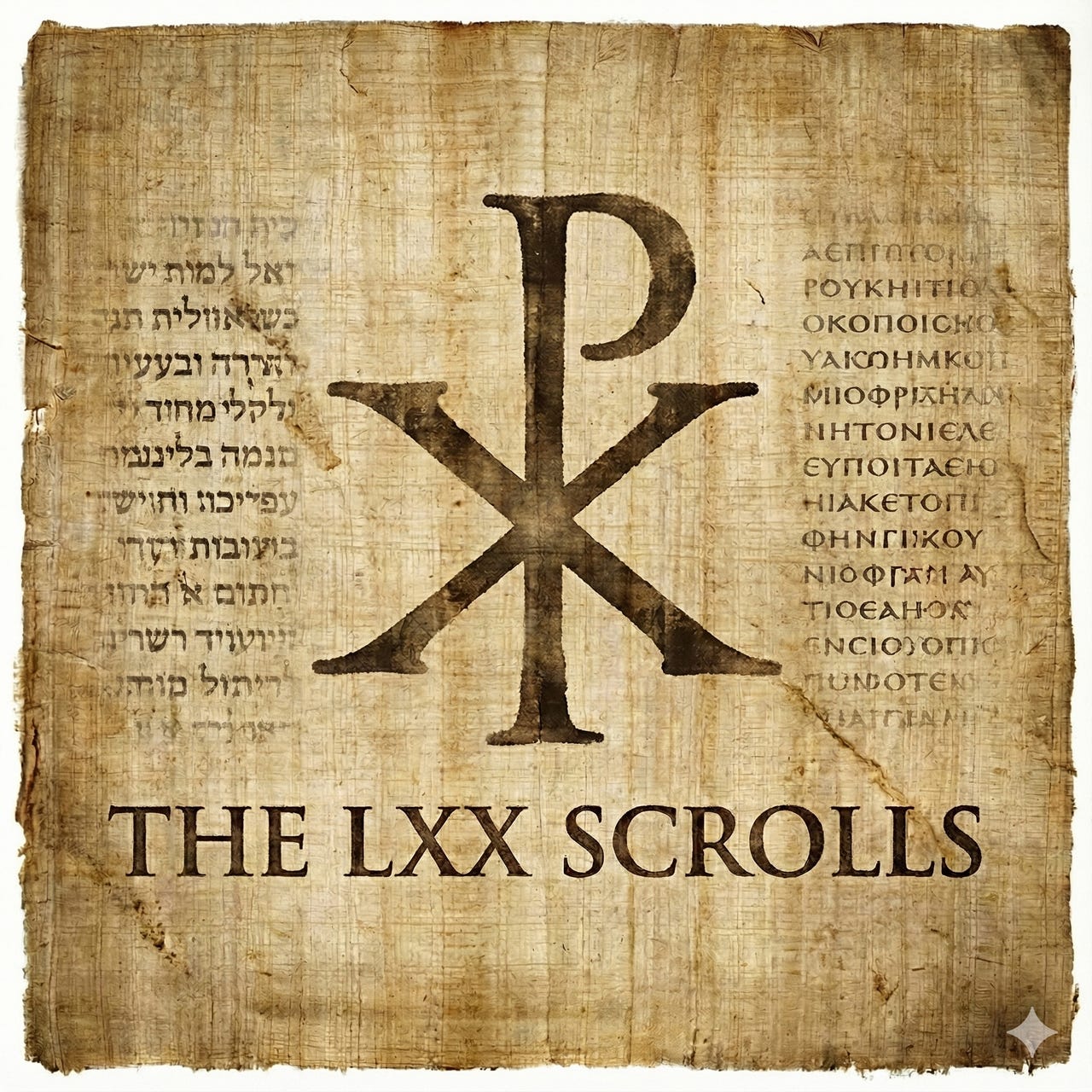
The Word “Christos” in the Septuagint
Before we can understand how the Septuagint prepared the world for Jesus, we need to understand one crucial word: Χριστός (Christos).
In Hebrew, the word is מָשִׁיחַ (mashiach), and it means “anointed one.” In the Old Testament, this word was applied broadly. Priests were anointed with oil when they were consecrated for service (Leviticus 4:3). Kings were anointed when they took the throne; David was “the Lord’s anointed” (1 Samuel 24:6). Even Cyrus, the Persian king who allowed the Jews to return from exile, is called God’s “anointed” in Isaiah 45:1.
So mashiach wasn’t originally a technical term for The Messiah. It was a general description of anyone who had been ritually anointed for a specific purpose.
But something happened when Jewish scholars translated the Hebrew Scriptures into Greek.
They chose the word Χριστός (Christos) to translate mashiach. And over the next one-to-two centuries, as Greek-speaking Jews read their Bibles, something remarkable occurred: the word Christos began to acquire messianic freight. It started pointing to the coming deliverer, the promised king, the one who would rescue Israel and establish God’s kingdom.
By the time of Jesus, when Peter stood up on the day of Pentecost and declared, “God has made this Jesus, whom you crucified, both Lord and Christ” (Acts 2:36), his audience didn’t need a definition. They knew what “Christos” meant. They’d been reading it in their Scriptures their entire lives.
Let me show you a few examples.
Psalm 2:2 (Septuagint): “The kings of the earth set themselves, and the rulers take counsel together, against the Lord and against His Christos.”
The Hebrew says “against the Lord and against His anointed.” But the Greek says “against His Christos.” Early Christians reading this in Greek saw it immediately: this is about Jesus. The world’s rulers conspired against God’s Christos and they crucified Him. But God raised Him up and established His kingdom anyway.
Daniel 9:25-26 (Septuagint): “Know therefore and understand: from the going forth of the word to restore and build Jerusalem until Christos the Prince, there shall be seven weeks and sixty-two weeks... And after the sixty-two weeks, the anointed one (Christos) will be cut off.”
We’ve explored Daniel’s Seventy Weeks prophecy in depth here on The LXX Scrolls, and it’s a fascinating, complex text. But here’s the key point for our purposes today: the Septuagint uses Christos to describe the coming prince who will be “cut off”— killed, executed —after sixty-nine “weeks” of years.
By the time Jesus was born, Greek-speaking Jews reading Daniel knew that Christos was coming. They knew He would be a prince. They knew He would die (although, in fairness, most Jews had internalized their ignoring of the passages of the suffering servant Messiah in preference for the reigning king Messiah). They just didn’t know where or who. It can be argued that they didn’t know when, though I would contend that those who took their Scriptures seriously would at least know the year if not the day, on account of Daniel’s prophecy, which perfectly predicts the year in which Jesus was Crucified (so long as you have the correct starting date).
The Septuagint had successfully prepared them to recognize Jesus when He came, however.
Isaiah 61:1 (Septuagint): “The Spirit of the Lord is upon me, because the Lord has anointed (christō) me to bring good news to the poor...”
Jesus Himself quoted this passage in the synagogue in Nazareth (Luke 4:18-21), and when He finished reading, He said, “Today this Scripture has been fulfilled in your hearing.”
The people in that synagogue knew the Septuagint. They’d heard this text before. And when Jesus claimed it was about Him, He was claiming to be the one whom God had anointed: the Christos.
Do you see what’s happening? For at least a century (and possibly two) before Jesus was born, Greek-speaking Jews had been reading about Christos in their Scriptures. The concept wasn’t invented by the apostles. It wasn’t a Christian innovation. It was embedded in the Greek Old Testament, waiting to be fulfilled.
When the New Testament writers proclaimed Jesus as “the Christ,” they weren’t making up a new title. They were declaring that the Christos the Septuagint had been pointing to had finally arrived.
Key Messianic Passages: A Quick Survey
The Septuagint didn’t just give Greek-speaking Jews the word Christos. It gave them a whole library of messianic prophecies translated into the language of the known world.
Let me take you on a brief tour of a few key passages. Some of these we’ve explored in depth in previous posts, so I’ll just touch on them briefly here and point you to those deeper analyses if you want more detail.
Isaiah 7:14 - The Virgin Birth
In the Hebrew Masoretic Text, Isaiah 7:14 says, “Behold, the almah shall conceive and bear a son, and shall call his name Immanuel.”
The word almah means “young woman.” It could refer to a virgin, but it doesn’t explicitly require virginity. It’s a somewhat ambiguous term.
But the Septuagint translators chose a much more specific Greek word: παρθένος (parthenos), which unambiguously means “virgin.”
When Matthew quotes this prophecy in Matthew 1:23— ”Behold, the virgin shall conceive and bear a son, and they shall call his name Immanuel” —he’s quoting the Septuagint, not the Hebrew.
Why does this matter? Because the Septuagint reading makes the sign more miraculous, more specific, more clearly supernatural. A young woman conceiving is normal. A virgin conceiving is a miracle. And Matthew saw in Mary’s virgin conception the fulfillment of what the Septuagint had been saying for over a century.
We explored this passage in depth in my inaugural post, The Virgin and the Young Woman, where we examined Isaiah 7:14 in detail. If you want the full textual analysis, I’d encourage you to check that out. For today, the key point is this: the Septuagint prepared the early church to see Jesus’ virgin birth as the fulfillment of Isaiah’s prophecy.
Psalm 22 - The Crucifixion Psalm
Psalm 22 is one of the most stunning messianic prophecies in the entire Old Testament. It describes, in vivid detail, what looks like a crucifixion, yet it was written centuries before crucifixion was invented.
In verse 16, there’s a textual difference that matters enormously:
The Masoretic Hebrew reads: “Like a lion, my hands and feet” (כָּאֲרִי יָדַי וְרַגְלָי, ka’ari yaday ve-raglay)
The Septuagint reads: “They pierced my hands and feet” (ὤρυξαν χεῖράς μου καὶ πόδας, ōryxan cheiras mou kai podas)
The Hebrew is difficult and somewhat obscure. “Like a lion my hands and feet” doesn’t quite make sense grammatically. Some scholars think there’s a textual corruption in the Hebrew.
But the Septuagint reading is crystal clear: “They pierced my hands and feet.”
When Jesus was crucified— when Roman soldiers drove nails through His hands and feet —early Christians reading Psalm 22 in the Septuagint saw the prophecy fulfilled before their eyes.
The Septuagint prepared them to understand what had happened at Calvary.
Again, we’ve already covered this in depth. For the full treatment, see my post, Like a Lion or They Pierced? The Psalm 22 Mystery
Isaiah 53 - The Suffering Servant
Isaiah 53 is perhaps the most explicit prophecy of Jesus’ death and resurrection in the entire Old Testament. Both the Hebrew Masoretic Text and the Greek Septuagint describe the Suffering Servant in nearly identical terms:
He was despised and rejected. He bore our sins. He was wounded for our transgressions. He was silent before His accusers. He was numbered with transgressors. He made intercession for sinners. God made His life an offering for sin. After His suffering, He will see the light of life.
The differences between the Hebrew and the Greek are minimal here. Both traditions preserved this prophecy with stunning clarity.
But here’s the key detail for our purposes: when Philip met the Ethiopian eunuch in Acts 8, the eunuch was reading Isaiah 53. In Greek, from the Septuagint. He asked Philip, “About whom does the prophet say this, about himself or about someone else?” (Acts 8:34).
And Philip, starting with that very Scripture, told him the good news about Jesus.
The Septuagint had been in the eunuch’s hands. The prophecy had been waiting for centuries. And when Philip explained that it was about Jesus, the eunuch believed and was baptized.
The Septuagint prepared him to recognize the Messiah.
We recently explored Isaiah 53 in a 4-part series here on The LXX Scrolls, particularly in connection with messianic prophecy and the theme of substitutionary atonement. If you’d like to take the deep dive, here’s the first part of that exploration:

Genesis 3:15 - The Seed of the Woman
This is one of my favorite passages to compare between the Hebrew and the Greek, and yet again we’ve done an extensive analysis of it in a previous post.
In the Masoretic Text, Genesis 3:15 says that the seed of the woman will “bruise” or “crush” (שׁוּף, shuph) the serpent’s head, and the serpent will “bruise” or “crush” the seed’s heel.
In the Septuagint, the verb is τηρέω (tēreō), which means “to watch” or “to guard.” So the Greek emphasizes ongoing vigilance; the seed will watch the serpent’s head, and the serpent will watch the seed’s heel.
Both readings point to Christ. The Hebrew emphasizes the decisive victory as Christ crushes Satan’s head at the cross and resurrection. The Greek emphasizes the ongoing spiritual warfare since believers must remain vigilant against the serpent’s attacks until Christ returns.
For today’s purposes, the key point is this: both the Hebrew and the Greek preserve the first promise of the Gospel. And Greek-speaking Jews reading Genesis 3:15 in the Septuagint understood that God had promised a Redeemer from the very beginning. The “seed of the woman” would defeat the serpent. They just didn’t know yet that the seed would be born of a virgin in Bethlehem.
Other Messianic Passages in Brief
Let me quickly mention a few other key prophecies preserved in the Septuagint:
Isaiah 9:6 - “For to us a child is born, to us a son is given... and his name shall be called Wonderful Counselor, Mighty God, Everlasting Father, Prince of Peace.”
The Septuagint preserves these stunning titles. When Greek-speaking Jews read that the coming child would be called “Mighty God,” they understood: this isn’t just another human king. This is God Himself, coming in the flesh.
Micah 5:2 - “But you, O Bethlehem Ephrathah, who are too little to be among the clans of Judah, from you shall come forth for me one who is to be ruler in Israel, whose coming forth is from of old, from ancient days.”
The Septuagint makes clear that the one born in Bethlehem has eternal origins. He’s not just a human descended from David. He existed “from ancient days” (ie: from eternity).
Zechariah 9:9 - “Rejoice greatly, O daughter of Zion! Shout aloud, O daughter of Jerusalem! Behold, your king is coming to you; righteous and having salvation is he, humble and mounted on a donkey.”
When Jesus rode into Jerusalem on Palm Sunday (Matthew 21:5, John 12:15), He was fulfilling what the Septuagint had been saying for a lifetime: your King is coming. And He’s not coming on a warhorse like a conquering general. He’s coming humbly, on a donkey, bringing salvation.
Do you see the pattern? Prophecy after prophecy in the Septuagint pointed to Jesus. The Greek-speaking world had the Scriptures in their own language, and those Scriptures were preparing them— whether they knew it or not —to recognize the Messiah when He came.
The Providence of Timing
Now let’s zoom out and look at the bigger picture. Because the existence of the Septuagint isn’t just interesting trivia. It’s evidence of God’s meticulous preparation for the Gospel.
Think about the timing.
Alexander the Great dies in 323 B.C. His empire fractures, but Greek remains the universal language across the Mediterranean world. From Egypt to Syria, from Greece to Rome, educated people speak Greek. It becomes the lingua franca— the common tongue —of the known world.
Around 270 B.C., Jewish scholars begin translating the Torah into Greek. The project continues over the next 150+ years until the entire Old Testament exists in Greek translation.
By the time Jesus is born (around 4 B.C.), Greek is everywhere, the Septuagint is everywhere, and synagogues are everywhere. Wherever Jews have settled— Alexandria, Antioch, Rome, Corinth, Ephesus —they have copies of the Greek Scriptures. God-fearing Gentiles can walk into a synagogue, hear the Scriptures read in Greek, and understand them.
By the time Paul begins his missionary journeys (around 46 A.D.), the infrastructure for the Gospel is already in place. Paul’s strategy is consistent: go to the synagogue first, reason from the Scriptures, show that Jesus is the Christos the Scriptures promised. And which Scriptures does Paul use? The Septuagint. The Greek Old Testament that his audiences already knew and trusted.
Do you see the providence here? God wasn’t scrambling. He was orchestrating.
For centuries, He laid groundwork:
The Roman Empire built roads that allowed rapid travel across the Mediterranean
Alexander’s conquests made Greek the universal language
Jewish translators rendered the Hebrew Scriptures into Greek
Synagogues spread across the empire, creating centers where Scripture was read and discussed
The concept of “Christos” took root in the Greek-speaking Jewish consciousness
When the angel said to Mary, “The time has come,” it really had. Everything was ready.
The Roman roads allowed the apostles to travel quickly from city to city. The Greek language allowed them to communicate universally. The Septuagint allowed them to prove from Scripture that Jesus was the promised Messiah. The synagogues gave them starting points in every city; places where people already gathered to hear God’s Word.
Paul says it beautifully in Galatians 4:4-5: “But when the fullness of time had come, God sent forth his Son, born of woman, born under the law, to redeem those who were under the law, so that we might receive adoption as sons.”
The fullness of time. Not a moment too soon. Not a moment too late. Exactly when everything was ready.
And the Septuagint was one crucial piece of that preparation.
Why the Septuagint Still Matters Today
You might be thinking, “Okay, this is fascinating history. But what does it mean for me? Why should I care about a 2,000-year-old Greek translation?”
Let me give you three reasons.
1. It Shows Us How the Apostles Read Scripture
When Paul writes to the Romans, he quotes the Old Testament more than 60 times. When he writes to the Corinthians, Galatians, and Ephesians… in every case he’s constantly quoting Scripture to make his arguments.
And in the vast majority of cases, Paul is quoting the Septuagint, not a text that aligns with the Hebrew Masoretic Text.
If we want to understand Paul’s theology, if we want to follow his arguments, if we want to see how he proved Jesus was the Messiah, then we need to read the Bible Paul read. We need to pay attention to the Septuagint.
The same is true for Peter. When he stands up on Pentecost and quotes Joel 2 and Psalm 16 to prove that Jesus is the risen Messiah, he’s quoting the Septuagint. When he writes his epistles and quotes Isaiah and the Psalms, he’s using the Greek text.
The apostles weren’t inventing their theology from scratch. They were reading the Old Testament— specifically, the Septuagint —and discovering Jesus on every page.
If we want to read the Bible the way the apostles did, we need to pay attention to the Septuagint.
2. It Demonstrates God’s Multi-Layered Revelation
One of the beautiful things about comparing the Masoretic Text and the Septuagint is that the differences between them aren’t errors or contradictions. They’re different facets of the same diamond.
Sometimes the Hebrew emphasizes one truth, and the Greek emphasizes another. Sometimes the Hebrew is more literal, and the Greek is more interpretive. Sometimes the Hebrew preserves one textual tradition, and the Greek preserves another.
But both are inspired. Both are God’s Word. Both point to Jesus.
God didn’t give us one monolithic text that came down from heaven fully formed and unchanged. He gave us His Word through human authors, through human translators, through multiple communities of faith, across multiple languages and centuries.
And all of it— Hebrew, Greek, Aramaic, all the manuscripts and translations —all of it converges on Jesus.
That’s not a weakness. That’s a strength. It shows that God’s revelation is rich, layered, multifaceted. No single translation can capture everything. But when we compare them, when we hold them together, we see the full picture more clearly.
The Septuagint enriches our understanding of the Old Testament. It shows us how ancient Jewish translators understood their own Scriptures. It gives us insight into how the apostles read and interpreted those Scriptures. It adds depth and texture to our reading.
3. It Prepares Us for Christmas
Here’s the most important reason the Septuagint matters today: it reminds us that Christmas isn’t just about a baby in a manger.
Christmas is the culmination of centuries of promises, prophecies, and preparation.
When we read the Old Testament— in any translation —we’re reading the script that pointed to Bethlehem. Every prophecy, every promise, every type and shadow was pointing forward to Jesus.
The Septuagint is one piece of evidence— one beautiful, concrete piece of evidence —that God was preparing the world for His Son.
And if God took centuries to prepare for Jesus’ first coming, orchestrating history, translating Scriptures, spreading languages, building roads, establishing synagogues— if He went to that much trouble to make sure the world was ready for Christmas —then we can trust that He’s equally precise and intentional in everything else He does.
God plays the long game. He doesn’t rush. He doesn’t improvise. He doesn’t leave things to chance.
The same God who orchestrated world history to prepare for Christ’s first coming is orchestrating history for His second coming. Nothing catches Him by surprise. Everything is on schedule. Every promise will be fulfilled.
The Long Game
Let me close with this thought.
250 years before Jesus was born, Jewish scholars in Alexandria began translating Hebrew prophecies into Greek. They had no idea they were preparing the world to receive the Gospel. They were just trying to preserve their Scriptures for Greek-speaking Jews who were losing fluency in Hebrew.
They didn’t know that “almah” would become “parthenos,” and that Matthew would quote their translation to prove Jesus’ virgin birth.
They didn’t know that “like a lion my hands and feet” would become “they pierced my hands and feet,” and that Christians would read Psalm 22 and see Jesus on the cross.
They didn’t know that their translation of Isaiah 53 would be in an Ethiopian eunuch’s hands when Philip climbed into his chariot and preached Jesus to him.
They didn’t know that Paul would quote their Greek text in synagogue after synagogue across the Roman Empire, proving that Jesus is the Christos their translation had been pointing to all along.
But God knew.
God was working. God was preparing. God was orchestrating every detail, every translation choice, every word, so that when Jesus came, the world would be ready to hear about Him.
This Christmas, as you celebrate the Incarnation, remember: Jesus didn’t arrive unexpectedly. He arrived exactly when God had always planned.
The stage was set. The language was ready. The text was ready. The world was ready.
And centuries before the angels sang over Bethlehem, God was already preparing the way.
A Practical Encouragement
As we approach Christmas this year, I want to encourage you to do something.
Read the Old Testament prophecies. Any translation (even your English Bible, be it King James, NRSV, or even NLT or The Message) will do just fine. But as you read, pay attention to how clearly they point to Jesus.
Read Isaiah 7:14 and marvel that God promised a virgin birth.
Read Micah 5:2 and marvel that God specified the exact town where the Messiah would be born.
Read Isaiah 9:6 and marvel that God promised His Son would be called “Mighty God.”
Read Psalm 22 and Isaiah 53 and marvel that God described the crucifixion in detail, centuries before it happened.
And as you read, thank God that He prepared the world to receive His Son.
Thank Him that He didn’t leave it to chance. Thank Him that He worked for centuries, through translators and scribes and copyists and scholars, to make sure the message would be clear.
Thank Him that when Jesus came, the Scriptures were ready to testify about Him.
And trust that the same God who orchestrated history for Christ’s first coming is orchestrating everything— including your life —for His second coming and His eternal glory.
God keeps His promises. He always has. He always will.
The Septuagint is proof.
Looking Forward
We’re just a few days away from Christmas. The stores are crowded. The to-do lists are long. The stress is real.
But in the midst of it all, take a moment to step back and see the big picture.
God spent centuries preparing for Christmas. He didn’t rush. He laid careful, meticulous groundwork. He made sure that when Jesus came, the world would be ready to hear about Him.
And He’s still working. He’s still orchestrating. He’s still preparing the way, this time for Christ’s return.
So as we wait— as we celebrate Christmas and anticipate the second coming —we can trust the same divine precision that brought Jesus to Bethlehem.
Nothing is accidental. Nothing is left to chance. Everything is on schedule.
The same God who prepared the Septuagint for the Gospel is preparing you for whatever comes next in your life. He’s working. He’s faithful. He keeps His promises.
Merry Christmas.
And may you see Jesus— the Christos, the Anointed One, the fulfillment of every promise —on every page of Scripture you read.
If you’ve found this helpful or insightful, please share it with a friend who loves Scripture as much as you do.
And if you want to go deeper with a full exploration of the “70 Weeks” of Daniel 9, a deep exploration of biblical idolatry with modern context, and other exclusive content, consider becoming a paid subscriber. Your support makes this work possible.
On the other hand, if you appreciate what I’m doing and want to support this work but aren’t interested in a membership, please consider buying me a coffee as a one-time show of support

© 2025 LXX Scrolls. All rights reserved.