

Mary’s Song
The Magnificat as a Christmas Morning Prayer
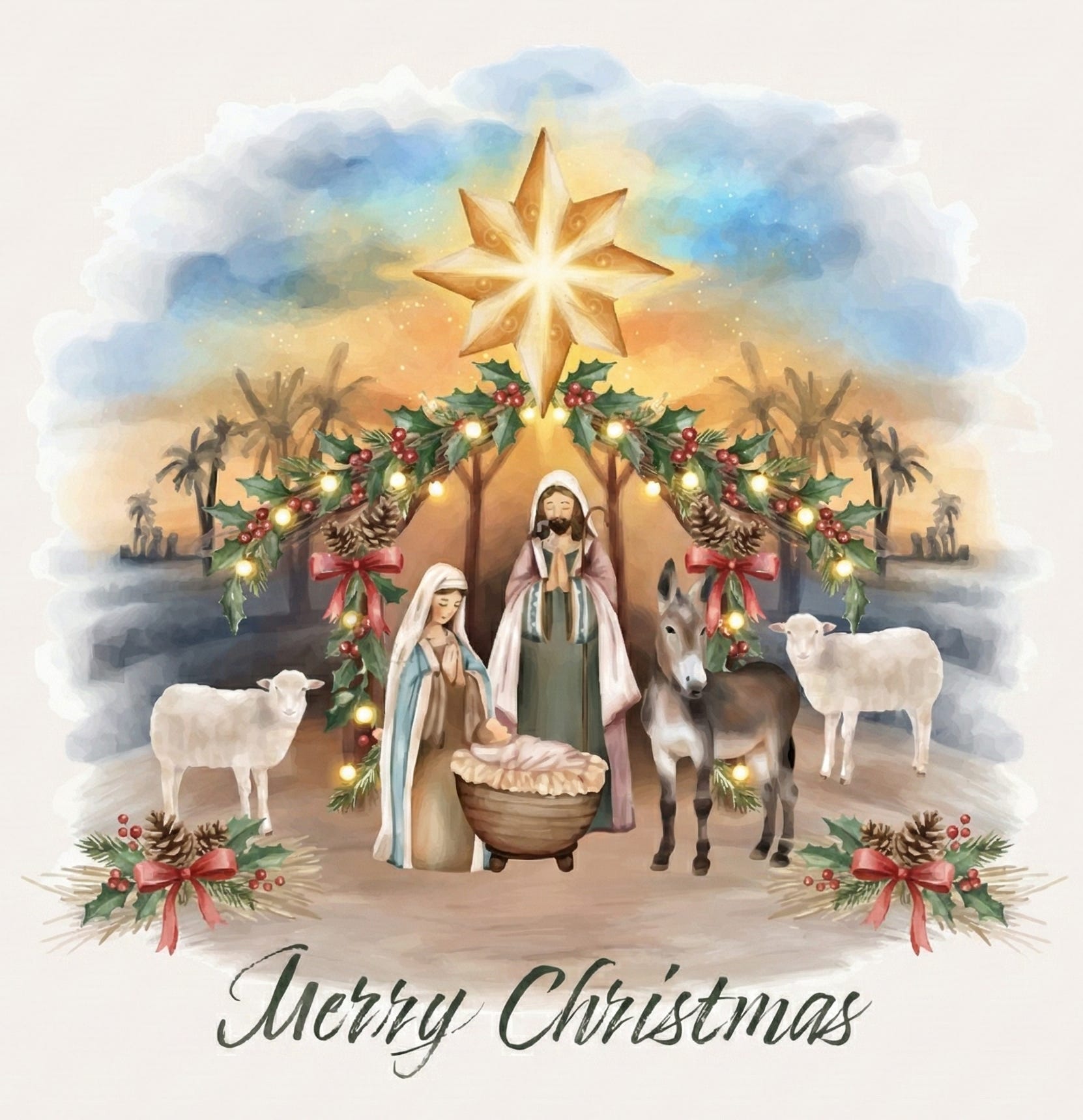
Good morning and Merry Christmas, brothers and sisters.
It’s Christmas morning. The presents are wrapped, the family is gathering, the coffee is brewing. Before the busyness begins, before the wrapping paper flies, take just a few minutes to pray with Mary.
Not the silent, gentle Mary of Christmas cards, though she was certainly gentle. Not the perpetually serene Mary of stained glass windows, though none can argue that she trusted God completely.
The Mary of Scripture. The Mary who, when the angel told her she would bear the Messiah, burst into song. And what a song it was!
The Magnificat is a song of praise to the God who sees the lowly, who keeps His promises, who turns the world’s expectations upside down to shower us with grace.
This Christmas morning, let’s listen to Mary. Let’s pray her prayer. Let’s let her song of praise shape how we see the baby in the manger.
Because once you hear what Mary sang about God’s character and His glorious gift to humanity, Christmas will never look the same again.
If you’re reading this in email, be aware that the text is likely to cut off without warning. For a smoother reading experience and all the features Substack has to offer (including audio voiceovers of my posts), you can go HERE or download the app.
The Song Itself
When Mary visits her cousin Elizabeth— both of them miraculously pregnant —Elizabeth greets her with a blessing. And Mary responds with one of the most beautiful prayers in all of Scripture.
Here’s what she sang, from Luke 1:46-55:
“My soul magnifies the Lord, and my spirit rejoices in God my Savior, for he has looked on the humble estate of his servant. For behold, from now on all generations will call me blessed; for he who is mighty has done great things for me, and holy is his name. And his mercy is for those who fear him from generation to generation. He has shown strength with his arm; he has scattered the proud in the thoughts of their hearts; he has brought down the mighty from their thrones and exalted those of humble estate; he has filled the hungry with good things, and the rich he has sent away empty. He has helped his servant Israel, in remembrance of his mercy, as he spoke to our fathers, to Abraham and to his offspring forever.”
Let that sink in for a moment. Mary, a teenage girl from Nazareth, carrying the Son of God in her womb, doesn’t focus on herself. She focuses on God.
The Greek word she uses is μεγαλύνει (megalynei): ”magnifies.” But she’s not making God bigger. God is already infinite. She’s making Him look bigger to everyone else. She’s lifting Him up. She’s declaring His greatness.
And the word for her “humble estate” is ταπείνωσιν (tapeinōsin): her lowliness, her insignificance in the eyes of the world. Mary knows she’s nobody special by the world’s standards. But God has looked on her. God has chosen her. God has done great things for her.
That’s the pattern of the whole song: Mary starts with what God has done for her personally, then zooms out to show that this is what God always does. This is who He is.
Mary Prays Like Hannah
Mary didn’t come up with this song out of nowhere. She was steeped in Scripture. Specifically, the Septuagint, the Greek translation of the Old Testament that Jewish families like hers would have known by heart.
Her Magnificat deliberately echoes another song: Hannah’s prayer in 1 Samuel 2:1-10.
Hannah, like Mary, experienced an impossible pregnancy. Hannah was barren, and God opened her womb to give her Samuel. Hannah responded with a song of praise that sounds remarkably like Mary’s:
Hannah said, “My heart exults in the Lord” (1 Samuel 2:1). Mary said, “My soul magnifies the Lord.”
Hannah said, “There is none holy like the Lord” (1 Samuel 2:2). Mary said, “Holy is his name.”
Hannah sang, “He raises up the poor from the dust; he lifts the needy from the ash heap” (1 Samuel 2:8). Mary sang, “He has brought down the mighty from their thrones and exalted those of humble estate.”
Do you see the pattern? Mary isn’t just making up theology on the spot. She’s praying what she’s learned from God’s Word. She’s seen this pattern her whole life in Scripture: God uses the weak to accomplish His purposes. God lifts the lowly. God shows mercy to those who fear Him.
And now Mary realizes: I’m part of that story. God is doing it again. Through me.
A barren woman gave birth to Samuel, who anointed David the king. Now a virgin is giving birth to Jesus, the Son of David, the King of kings.
God’s faithfulness spans generations. What He promised to Abraham, He’s fulfilling through Mary. What He’s always done, He’s doing again.
The God Who Sees the Lowly
Let’s pause on this for a moment, because it’s central to everything Christmas means.
Mary uses the word ταπείνωσις (tapeinōsis) to describe herself: ”humble estate,” “lowliness.” This is the same word used throughout the Greek Old Testament for the oppressed, the marginalized, the overlooked, the nobodies.
And Mary is saying: That’s me. I’m one of the lowly. I’m one of the nobodies. But God saw me. God chose me. God did great things for me.
This is who God is. This is what He does. He doesn’t choose based on worldly qualifications. He doesn’t look for the impressive, the powerful, the well-connected. He looks on the lowly.
Think about it: God could have chosen anyone to bear His Son. He could have chosen a Roman noblewoman, a princess from a powerful family, someone with wealth and influence who could have given Jesus every earthly advantage.
Instead, He chose a teenage girl from Nazareth, a town so insignificant that when Nathanael heard Jesus was from there, he asked, “Can anything good come out of Nazareth?” (John 1:46).
God chose Mary precisely because she was lowly. He chose her to show the world that His kingdom doesn’t operate by the world’s rules.
And here’s the glorious truth: if God can use Mary, He can use you. If God saw her in her lowliness, He sees you in yours. You don’t have to be impressive. You don’t have to be qualified. You don’t have to have it all together.
God specializes in using the weak, the small, the overlooked. That’s the message of Christmas.
The God Who Keeps His Promises
Mary’s song isn’t just about her personal experience. It’s about God’s character and His faithfulness across all of history.
Listen to how she describes what God does:
“He has shown strength with his arm; he has scattered the proud in the thoughts of their hearts; he has brought down the mighty from their thrones and exalted those of humble estate; he has filled the hungry with good things, and the rich he has sent away empty.”
This isn’t abstract theology. This is Mary proclaiming what God has always done and will always do. He brings down the proud and lifts up the humble. He fills the hungry and sends the rich away empty. He shows mercy to those who fear Him.
And notice: Mary says God “has” done these things. Not “will do” or “might do.” Has done. It’s already accomplished. It’s certain. It’s God’s established pattern.
Why? Because this is who God is. This is His character. And God never changes.
The same God who raised up Joseph from a prison to save nations is the God who raised up David from a shepherd’s field to be king. The same God who heard the cries of Israel in Egypt and delivered them is the God who heard Hannah’s prayer and gave her a son. The same God who promised Abraham that through his offspring all nations would be blessed is the God who sent Jesus to be the Savior of the world.
God keeps His promises. Always. Every time. Without fail.
Mary ends her song by making this explicit: “He has helped his servant Israel, in remembrance of his mercy, as he spoke to our fathers, to Abraham and to his offspring forever.”
God didn’t forget Abraham’s descendants. He didn’t abandon His people. He didn’t break His covenant. He remembered His mercy. And when the time was right— in the fullness of time, as Paul says in Galatians 4:4 —God sent His Son, born of a woman.
Christmas is proof that God keeps His promises.
The Gift That Changes Everything
Now here’s where Mary’s song intersects with what we celebrate this Christmas morning.
Mary praises God for what He’s done for her: “He who is mighty has done great things for me, and holy is his name.”
What great things? God gave her the privilege of bearing the Messiah. God chose her to be the mother of the Savior. God allowed her to hold eternity in her arms.
But the great thing God did for Mary, He did for all of us.
The baby Mary carried is God’s gift to humanity. Jesus— Yeshua, “the Lord saves” —is the fulfillment of every promise God ever made. He is the seed of the woman who crushes the serpent’s head. He is the offspring of Abraham through whom all nations are blessed. He is the Son of David whose kingdom will never end. He is the Suffering Servant who bears our sins. He is the Light that shines in the darkness.
When God gave Mary Jesus, He was giving the world Jesus.
This is the wonder of Christmas. This is why we celebrate. Not because of lights and presents and traditions, though those are admittedly lovely. We celebrate because God gave us His Son.
“For God so loved the world, that he gave his only Son, that whoever believes in him should not perish but have eternal life” (John 3:16).
God looked on our lowliness— our sin, our brokenness, our desperate need —and He didn’t turn away. He sent Jesus.
God saw the hungry, and He filled them with the Bread of Life. God saw the darkness, and He sent the Light of the World. God saw us lost, and He sent the Good Shepherd. God saw us enslaved to sin, and He sent the Redeemer.
Mary praises God for doing “great things” for her. But the greatest thing God has done is for you. For me. For all of us.
He gave us Jesus.
Praying the Magnificat This Morning
So how do we pray with Mary this Christmas morning?
We start where she started: with personal gratitude.
Mary said, “My soul magnifies the Lord, and my spirit rejoices in God my Savior, for he has looked on the humble estate of his servant.”
Take a moment right now. Thank God for what He’s done in your life specifically. Thank Him for seeing you. Thank Him for choosing you. Thank Him for the gift of Jesus, personally given to you.
Maybe you’re thinking, “But I’m not worthy. I’m not special. I don’t deserve God’s attention.”
Exactly. Neither was Mary, by the world’s standards. That’s the point. God doesn’t wait for us to be worthy. He looks on our lowliness and loves us anyway.
Then do what Mary did: zoom out. Recognize that your story fits into God’s larger story.
God has always worked this way. He has always chosen the weak. He has always lifted the lowly. He has always kept His promises. He has always shown mercy to those who fear Him.
The same God who worked in Abraham’s life, who answered Hannah’s prayer, who chose Mary to bear His Son; that God is working in your life too.
So praise Him. Magnify Him. Lift Him up. Declare His greatness.
You might pray something like this:
“Lord, You are great and greatly to be praised. You have done great things for me. You’ve given me Jesus. You’ve saved me. You’ve called me Your child. You’ve loved me when I didn’t deserve it.
You are the God who sees the lowly. You saw me. You chose me. You didn’t wait for me to get my act together. You pursued me while I was still a sinner.
You are the God who keeps promises. You promised a Savior, and You sent Jesus. You promised eternal life, and You give it freely to all who believe. You promised never to leave or forsake me, and You never have.
Holy is Your name. You are mighty. You are merciful. You are faithful.
Thank You for Christmas. Thank You for the baby in the manger. Thank You for the gift of Jesus, my Savior and Lord.
My soul magnifies You this morning. All glory, all honor, all praise belongs to You.”
Carrying the Song With You
Now go. Open presents. Hug your family. Enjoy your Christmas breakfast. Laugh. Celebrate. Savor this day.
But carry Mary’s song with you.
Remember that the baby you’re celebrating is the God who sees the lowly. The God who keeps His promises. The God who gives good gifts to His children.
Remember that Christmas isn’t about you being good enough to earn God’s favor. It’s about God looking on your lowliness and loving you anyway.
Remember that the same God who chose Mary to bear His Son has chosen you to bear His image, to carry His light, to proclaim His goodness to the world.
Remember that God keeps His promises. He sent Jesus the first time, just as He promised. And He’ll send Jesus the second time, just as He’s promised. Everything God says, He does. Every word He speaks, He keeps.
Mary’s song is your song. Her God is your God. Her Savior is your Savior.
So magnify the Lord. Let your soul rejoice in God your Savior. Praise Him for what He’s done. Trust Him for what He’s promised. Worship Him for who He is.
Christmas is the celebration of God’s faithfulness, God’s mercy, God’s love. It’s the celebration of the greatest gift ever given: Jesus, the Son of God, born for us, given to us, offered freely to all who will receive Him.
He who is mighty has done great things for you. Holy is His name.
Merry Christmas.
Now go be with your family. Enjoy this day. And let everything you do today be an offering of praise to the God who gave us His Son.
© 2025 LXX Scrolls. All rights reserved.
What a beautiful meditation. What a wondrous Savior! Thank you.