

Was It a Blessing or a Curse? Isaac, Esau, and the Word That Changes Everything
How One Preposition Splits Two Ancient Traditions Apart — And Why Both Might Be Right

Hello brothers and sisters.
If you’ve read Genesis 27 more than once, you’ve probably noticed something strange about it.
Now before we go any further, I want to thank Sarah over at Extra Biblical Librarian for inspiring me to dig into this. We were talking about the bless/curse paradox in the angelic court in Job and she brought this one to my attention. If you’d like to read Sarah’s post on this you can check it out below:

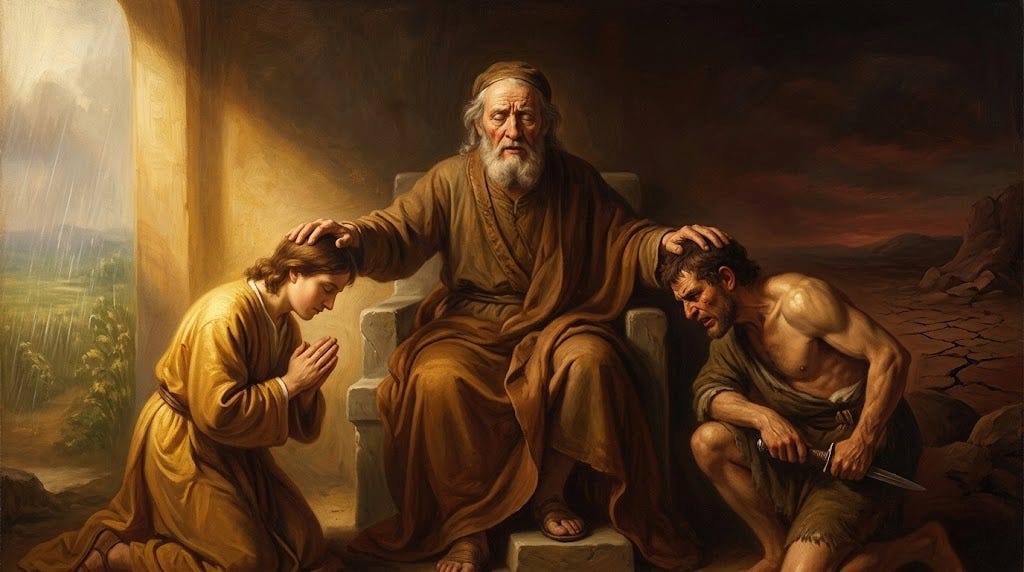
Jacob deceives his father. He steals his brother’s blessing. And when Esau comes in weeping, begging for anything his father has left to give, Isaac responds with what your English Bible probably presents as a watered-down version of the same blessing he just gave Jacob.
And if you’re paying attention, that doesn’t make sense.
Isaac himself says in verse 37: “I have made him your lord, and I have given all his brothers to him as servants. I have sustained him with grain and wine. What then can I do for you, my son?”
In other words: I have nothing left to give.
And yet, just two verses later, your Bible might tell you that Isaac blessed Esau with the fatness of the earth and the dew of heaven. The same things he gave Jacob.
Something doesn’t add up.
Unless, of course, the text doesn’t actually say what you think it says.
Let’s get into it.
If you’re reading this in email, be aware that the text is likely to cut off without warning. For a smoother reading experience and all the features Substack has to offer (including audio voiceovers of my posts), you can go HERE or download the app.
The Preposition That Divides
Let’s look at the key verse. Here’s how three major translations handle Genesis 27:39:
NKJV:
“Behold, your dwelling shall be of the fatness of the earth, and of the dew of heaven from above.”
NRSV:
“See, away from the fatness of the earth shall your home be, and away from the dew of heaven on high.”
N.E.T.S. (Septuagint):
“See, away from the fatness of the earth shall your dwelling be, and away from the dew of heaven on high.”
Did you catch that? The NKJV says Esau will live of— that is, partaking in —the richness of the earth. The NRSV and the Septuagint say Esau will live away from it. Cut off from it. Denied it.
That’s not a nuance. That’s a completely opposite meaning. One is a diminished blessing. The other is closer to a curse.
So which is it?
The Problem in the Hebrew
The culprit is a tiny Hebrew preposition: מִן (min). It’s one of the most common words in the Hebrew Bible, and it can mean several different things depending on context.
When מִן follows a verb of giving— as it does in verse 28, where Isaac blesses Jacob —it functions as a partitive. It means “some of,” or “a portion of.” So when Isaac says to Jacob, “May God give you of (מִן) the dew of heaven, and of (מִן) the fatness of the earth,” he’s saying: May you receive a share of these good things.
But when מִן follows a noun of place or dwelling— as it does in verse 39 —it typically functions as a privative. It means “away from,” “far from,” or “without.” So when Isaac says to Esau, “Your dwelling shall be from (מִן) the fatness of the earth, and from (מִן) the dew of heaven,” the grammar most naturally reads: Your home will be far from fertile land, far from the rains of heaven.
This is exactly what the great 19th-century commentators Keil and Delitzsch observed. They noted that Isaac deliberately used the same expression as in verse 28 but in the opposite sense. In Jacob’s blessing, מִן is partitive, imparting a share. In Esau’s pronouncement, מִן is privative, denying it.
It’s a devastating wordplay. Isaac echoes the language of blessing, but inverts it into a prophecy of deprivation. The very words that gave Jacob abundance now strip Esau of the same.
Albert Barnes made the same observation, noting that after a verb of giving, מִן takes the partitive sense, but after a noun of place it denotes separation. He compared it to Proverbs 20:3, where מִן likewise carries the sense of “apart from.”
Not everyone agrees, of course. Some older translations, such as the KJV, the Vulgate, and even Calvin, read verse 39 as a genuine, if lesser, blessing. The argument is straightforward: why would we assign two opposite meanings to the same preposition in the same chapter? Why not let מִן mean the same thing both times?
It’s a fair objection. And honestly, it’s the kind of ambiguity that keeps scholars and translators arguing. But here’s the thing: we don’t have to rely on grammar alone to settle this. We have the Septuagint.
What Does the Greek Say?
The Septuagint translators, working in Alexandria at least two centuries before Christ, had to make a decision about this very ambiguity. And unlike some modern English translators, they didn’t try to smooth things over.
Here’s the Greek of verse 28 (Jacob’s blessing):
δῴη σοι ὁ θεὸς ἀπὸ τῆς δρόσου τοῦ οὐρανοῦ καὶ ἀπὸ τῆς πιότητος τῆς γῆς (dōē soi ho theos apo tēs drosou tou ouranou kai apo tēs piotētos tēs gēs)
“May God give you of the dew of heaven and of the fatness of the earth.”
And here’s verse 39 (Esau’s pronouncement):
ἰδοὺ ἀπὸ τῆς πιότητος τῆς γῆς ἔσται ἡ κατοίκησίς σου καὶ ἀπὸ τῆς δρόσου τοῦ οὐρανοῦ ἄνωθεν (idou apo tēs piotētos tēs gēs estai hē katoikēsis sou kai apo tēs drosou tou ouranou anōthen)
“Behold, away from the fatness of the earth shall be your dwelling, and away from the dew of heaven from above.”
Here’s what’s fascinating: the Greek uses the exact same preposition— ἀπό (apo) —in both verses. Just like the Hebrew uses מִן in both. But the grammatical context forces different readings. In verse 28, ἀπό follows a verb of giving (δῴη, dōē), so it means “some of.” In verse 39, ἀπό describes the location of a dwelling (κατοίκησις, katoikēsis), so it means “away from.”
The N.E.T.S. translation of the Septuagint reflects this clearly: “See, away from the fatness of the earth shall your dwelling be.”
The Septuagint translators understood exactly what was happening in this text. They preserved the word play of the Hebrew by using the same Greek preposition in both verses along with a sentence structure that makes the meaning unmistakable.
For Jacob: a portion of the earth’s bounty. For Esau: exile from it.
Jubilees Agrees — And Goes Further
The Book of Jubilees, written sometime in the second century B.C., retells this scene and removes all ambiguity. Here’s what it says:
“And Isaac answered and said unto him: ‘Behold, far from the dew of the earth shall be thy dwelling, And far from the dew of heaven from above. And by thy sword wilt thou live, And thou wilt serve thy brother. And it shall come to pass when thou becomest great, And dost shake his yoke from off thy neck, Thou wilt sin a complete sin unto death, And thy seed will be rooted out from under Heaven.‘” (Jubilees 26:33-34)
Did you catch that ending? Jubilees doesn’t just agree with the “away from” reading, it goes considerably further. It adds an explicit prophecy that when Esau’s descendants finally break free from Jacob’s dominion, they will “sin a complete sin unto death” and their line will be “rooted out from under Heaven.”
That’s not in the Masoretic Text. It’s not in the Septuagint. It’s Jubilees’ own interpretive expansion.
But its agreement with the “away from” reading is significant. The author of Jubilees was working from a Hebrew text tradition (likely one very close to what the Septuagint translators used) and he clearly understood Isaac’s words to Esau as the opposite of a blessing. Not a modified or diminished version of Jacob’s blessing. The opposite of it.
This gives us three ancient witnesses all pointing in the same direction: what Isaac spoke over Esau was not a blessing at all.
But Wait — What About Brenton?
I know some of you are looking at your Brenton Septuagint right now and saying, “Kevin, my Brenton says ‘of the fatness.’ Not ‘away from.’”
You’re right. Brenton does render it that way. And this is actually one of those moments where Brenton’s translation— as beloved and foundational as it is —smooths over a difficulty in the Greek rather than preserving it.
Brenton was working in 1851, and his translation philosophy leaned toward readability and concordance with the KJV where possible. When he encountered ἀπό in verse 39, he chose the partitive reading which matches the KJV and makes the passage sound like a blessing.
But this is widely recognized by scholars as a translation choice that obscures what the Greek actually communicates. The structure of the Greek sentence, with the dwelling (κατοίκησίς) as the subject and ἀπό marking spatial separation, points clearly to the meaning “away from.”
And the N.E.T.S., which is the product of the International Organization for Septuagint and Cognate Studies and represents the best modern scholarship on the Septuagint, renders it as “away from.” The N.E.T.S. translators were deliberately tracking how the Greek text differs from the Hebrew Masoretic tradition, and in this case, the sentence structure of the Greek makes “away from” the more accurate rendering.
This is a perfect example of why I keep saying we need to read multiple translations. No single translation— not even a phenomenal one —is capable of capturing everything.
What About Esau’s Reaction?
And here’s where the “away from” reading becomes almost impossible to deny.
Look at verse 41:
NRSV:
“Now Esau hated Jacob because of the blessing with which his father had blessed him, and Esau said to himself, ‘The days of mourning for my father are at hand; then I will kill my brother Jacob.’”
N.E.T.S. (Septuagint):
“And Esau was indignant at Iakob because of the blessing with which his father had blessed him. Then Esau said in his mind, ‘Let the days of mourning for my father come near in order that I may kill my brother Iakob.’”
Esau’s reaction is murderous rage. He plots to kill Jacob.
Now, ask yourself: if Isaac had just given Esau a genuine blessing (even a diminished one, even a lesser version of Jacob’s), why would Esau respond with homicidal fury?
Think about it. If Isaac said, “You too will have fertile lands and heavenly dew, just not as much as your brother,” that’s disappointing. It’s frustrating. But is it kill-your-brother level?
No. Esau’s response makes sense only if what he received was not a blessing at all. If Isaac looked at his weeping son and said, in essence: You will live in a barren land, far from rain, surviving by the sword, serving your brother, then Esau’s rage is perfectly understandable.
Isaac had nothing left to give. He said so himself in verse 37. And when he opens his mouth over Esau, what comes out is prophecy, not benediction. Isaac speaks what the Spirit gives him to speak. And what the Spirit declared over Esau was exile, deprivation, violence, and servitude.
There was just one thin thread of hope: that someday, Esau’s descendants would break free.
The Septuagint’s “away from” reading makes Esau’s reaction coherent. The traditional “of” reading does not.
The Rabbinic Tradition
It’s worth noting that the rabbinic tradition, too, understood the rivalry between Jacob and Esau as something far deeper than a squabble over who got the better crop yield.
Genesis Rabbah, the great midrashic commentary on Genesis compiled around the 5th century A.D., contains a famous teaching on verse 22: “The voice is Jacob’s voice, but the hands are the hands of Esau.” The rabbis read this as a prophetic declaration about the two brothers’ descendants.
Jacob’s power is in his voice: prayer, study, the spoken word.
Esau’s power is in his hands: warfare, dominion, physical might.
The Talmud (Gittin 57b) explicitly connects “the hands of Esau” with Rome, declaring that “the wicked kingdom that destroyed our Temple, burned our Sanctuary, and exiled us from our land” operated through the power of Esau’s hands. The Midrash (Genesis Rabbah 67:8) traces this enmity from Esau’s personal hatred of Jacob all the way to the Roman decrees against Israel.
And the Sifre (Beha’Alotcha 69), cited by Rashi, states bluntly that “it is a given fact that Esau hates Jacob.” He uses the word הלכה (halakhah), which normally refers to binding religious law. The hatred of Esau for Jacob isn’t just a family grudge. In the rabbinic mind, it’s a cosmic principle; a spiritual reality woven into the fabric of history.
Another fascinating midrashic tradition (Genesis Rabbah 65:5) says that Isaac’s blindness was caused by angelic tears falling on his eyes during the Binding (the Akedah, Genesis 22). When Abraham raised the knife over Isaac on Mount Moriah, the angels wept, and their tears permanently dimmed Isaac’s vision.
Other rabbis (Genesis Rabbah 65:10) attributed the blindness to the smoke of Esau’s Hittite wives burning incense to idols.
Either way, the tradition saw Isaac’s inability to see as divinely orchestrated, showing that God ensured the right son received the blessing.
What’s remarkable about all of this is that the rabbinic tradition, the Septuagint, and the Book of Jubilees all converge on the same basic reading: Esau did not receive a blessing. He received a prophecy. And it was not a kind one.
Isaac’s Blessing of Jacob: What the LXX Adds
Before we leave this chapter, it’s worth backing up to look at the blessing Isaac gives Jacob, because there’s a subtle but important difference in the Septuagint’s version.
In verse 28, the Masoretic Text has Isaac begin: “May God give you of the dew of heaven...” The word for God here is הָאֱלֹהִים (ha-Elohim): “the God.”
But the Septuagint adds something. In verse 7, when Rebecca recounts Isaac’s instructions to Esau, she says Isaac planned to bless Esau “before the Lord” (ἐναντίον κυρίου, enantion kuriou). It’s a phrase not present in the Masoretic Text. The LXX explicitly frames the patriarchal blessing as happening in the presence of God, with divine authority.
This is the kind of small addition that changes how you read the whole scene. If the blessing is given “before the Lord,” then it’s not just an old man’s wish. It’s a prophetic act with divine sanction. And that makes Jacob’s acquisition of it— deceptive as it was —an act of providence rather than mere trickery.
The irony is profound. Jacob uses deception to obtain what God had already ordained for him before birth (Genesis 25:23). Rebecca’s scheme is morally questionable, but the outcome aligns with what the Lord declared when the twins were still in the womb: “the older shall serve the younger.”
The “Sword” and the “Dagger”
Here’s another textual divergence worth noting. Verse 40 in the Masoretic Text says Esau will live “by your sword” (עַל־חַרְבְּךָ, al-charbecha). Most English translations follow this.
But the N.E.T.S. rendering of the Septuagint uses “by your dagger,” translating the Greek μάχαιρα (machaira), which can mean sword, knife, or dagger. This is a smaller weapon. More personal. More desperate.
It’s a subtle shift, but it paints a different picture. A man living by his sword conjures images of a warrior, a conqueror. A man living by his dagger sounds more like a highwayman, or a brigand. This is someone scraping by on the margins, surviving through opportunistic violence rather than glorious warfare.
Given that the Septuagint’s overall portrait of Esau’s “blessing” is one of deprivation and exile, the choice of μάχαιρα feels intentional. This isn’t a warrior’s destiny. It’s a survivor’s, and barely that.
“When You Break Loose”
The one ray of hope in Esau’s pronouncement comes in verse 40. But even here, the traditions differ in emphasis.
NKJV:
“It shall come to pass, when you become restless, that you shall break his yoke from your neck.”
NRSV:
“But when you break loose, you shall break his yoke from your neck.”
N.E.T.S. (Septuagint):
“But it shall be that when perchance you bring him down, then you shall loose his yoke from your neck.”
The Hebrew verb here is רוּד (rud), a rare word that appears to mean “to roam about freely” or “to have dominion.” In the Hiphil stem, it can mean “to tear oneself loose.” There’s a sense of restless energy, of someone who refuses to stay in subjection forever.
The Septuagint uses καθέλῃς (kathelēs), from a word meaning “to bring down” or “to pull down.” It suggests that Esau won’t just escape Jacob’s dominion, he’ll actively overthrow it.
And historically, this is precisely what happened. Edom was under Israelite control from the time of David (2 Samuel 8:13-14) until the reign of Jehoram of Judah, roughly 150 years later, when the Edomites revolted and won their independence (2 Kings 8:20-22). The prophecy was fulfilled with striking precision.
But remember what Jubilees adds: when Esau’s descendants finally break free, they will “sin a complete sin unto death.” Freedom, for the line of Esau, comes at a terrible cost.
What This All Means
So what do we do with this? Three traditions— the careful grammar of the Hebrew, the Septuagint in Greek, and the Book of Jubilees —all agree that what Isaac spoke over Esau was not a blessing. It was a prophecy of hardship, exile, and servitude, with a single conditional promise of eventual freedom.
Some English translations, particularly those in the KJV tradition, have obscured this by rendering מִן as “of” rather than “away from.” And it’s important to understand why. The translators weren’t being dishonest. The Hebrew genuinely allows for both readings. מִן is ambiguous in this context, and the KJV translators chose the reading that made Esau’s “blessing” sound more like an actual blessing.
But the Septuagint translators, working centuries closer to the original Hebrew text and with access to manuscript traditions we no longer possess, made a different choice. And their choice aligns with the internal logic of the narrative, with Esau’s murderous reaction, with the geographic reality of Edom (which was, as Malachi 1:3 confirms, a desolate land), and with the broader biblical pattern of God’s sovereign election.
This is one of those places where the both/and approach really shines.
If you read only the NKJV— if you take the “of the fatness” reading —you get a story about two brothers who both received blessings, one greater and one lesser. It’s a story about divine favoritism softened by fatherly love. Isaac, unable to undo what he’d done for Jacob, still managed to scrape together something decent for Esau.
If you read the NRSV and the Septuagint, taking the “away from the fatness” reading, you get a much harder story. A story where Jacob received everything and Esau received nothing. Where Isaac, speaking under prophetic compulsion, could not bless Esau even if he wanted to. Where the words that came out of his mouth were not blessings at all, but the grim pronouncement of a future defined by barren land, the blade, and bondage.
I believe the second reading is what the text actually says. The grammar supports it. The Septuagint supports it. Jubilees supports it. Esau’s reaction supports it. The historical reality of Edom supports it.
But I also believe there’s something important in the tension. Because God’s dealings with Esau are not the whole story. God is not done with anyone. The New Testament tells us that God’s mercy extends even to those who, like Esau, despised their birthright (Hebrews 12:16-17). The story of Esau is a warning, not a final verdict. Paul himself, reflecting on the mystery of divine election, reminds us: “I will have mercy on whom I will have mercy, and I will have compassion on whom I will have compassion” (Romans 9:15, echoing Exodus 33:19).
The Beauty of Comparing Texts
This is why I love doing what we do here. It’s the reason comparing the Masoretic Text and the Septuagint matters.
A single preposition. Two letters in Hebrew. Three letters in Greek. And it changes whether Isaac spoke a blessing or a curse over his eldest son.
Your English Bible chose one reading. The ancient traditions preserve what is likely the other. And when you hold them side by side, when you sit with the discomfort and the complexity and the ambiguity, you encounter a deeper truth than either reading offers alone.
You encounter a God who is sovereign in His choices. Who declared “the older shall serve the younger” before the twins drew breath. Who orchestrated events (even morally ambiguous events like Jacob’s deception) to bring about His purposes. And who, in the mystery of His wisdom, allowed His Word to be preserved in multiple traditions, each one revealing a different facet of the same diamond.
The Masoretic Text gives you the ambiguity. It lets you sit with the question: was it a blessing or not?
The Septuagint honors the ambiguity while it’s structure gives you a definite answer:
No, it wasn’t. It was a prophecy of exile. And the ancient readers knew it.
Together, they give you the full picture. And the full picture, as always, is richer than either tradition alone.
What do you think about all this? I’d love to hear your thoughts in the comments.
If you’ve found this work insightful or helpful, please share it with a friend who loves Scripture as much as you do.
And if you want to go deeper into the Word with a full exploration of the “70 Weeks” of Daniel 9, a deep 8-part exploration of biblical idolatry with modern context, an 8-part series exploring the idiom of a woman in travail as a metaphor for the end times, and other exclusive content (including the upcoming exploration of the Unseen Realm), consider becoming a paid subscriber for just $7/month. Your support keeps the scrolls unrolling.
On the other hand, if this work has blessed you but a paid membership isn’t feasible right now, please consider buying me a coffee as a one-time show of support


Hey friends, if you’re looking for your new favorite author you just might find it in the Journey Into More giveaway, where you’ll find around ten (as of this writing) books available for nothing more than your email address.

Also, just a reminder here that if you’re looking for an incredible new Christian book to lead you on a transformational journey without breaking the bank, I have just the thing!
Enter the Transformational books giveaway! Here you’ll find at least 28 (as of this writing) books promising transformation for the cost of nothing but your email address!
Do remember, of course, that by downloading any book from these giveaways you’ll be giving your consent to receive emails from the author in question.
And if you happen to be reading this without having subscribed to the LXX Scrolls, you’ll also have the opportunity to fix that and get my book, The Septuagint: An Introductory Analysis in either ebook or audio with your subscription.
© 2026 LXX Scrolls. All rights reserved.
I was literally thinking about this exact story today! In some sense, I find nothing offensive about God choosing to use Jacob and his bloodline as His vessel instead of Esau and the Edomites, but I am put off by the possible implication that God rejected Esau even before his birth. I understand that Jacob was already promised the inheritance, but was it still wrong for him to achieve it through deception? Was the forgiveness shown to Jacob by Esau a testament to his character and grace, or is that ultimately irrelevant? The story almost reminds me of Cain and Abel, except there seems to be some kind of worldly reconciliation here?